On Wednesday 18 November, students will sit two very different follow-on papers. BMO1 gives you three and a half hours for six problems requiring full proofs. The Senior Kangaroo gives you an hour for 20 questions, each with a three-digit numerical answer.
Our BMO preparation guide covers practice and proof-writing. Here I want to put the scores in context. Eleven out of 60 would be a worrying result in many school tests. In last November's BMO1, it was the median.
The 2026 SMC cut-offs
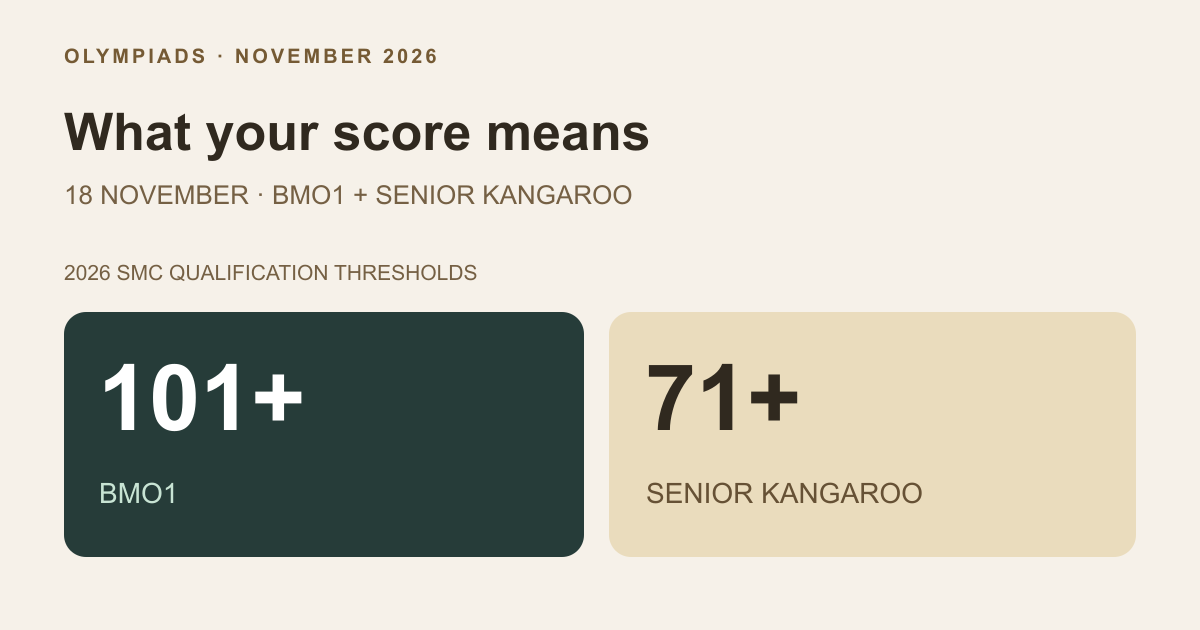
UKMT's published qualification thresholds are 101 for BMO1 and 71 for Senior Kangaroo, subject to the relevant eligibility rules. Around 1,000 eligible students qualify automatically for BMO1; the next roughly 8,000 are invited to Kangaroo, which is open to UK schools.
For comparison:
- 2026: BMO1 101; Kangaroo 71. SMC Gold 71, Silver 54, Bronze 41.
- 2025: BMO1 104; Kangaroo 72. Gold 72, Silver 57, Bronze 46.
- 2024: BMO1 110; Kangaroo 83. Gold 83, Silver 66, Bronze 49.
Those are qualification lines, not predictions of the score needed on the next paper. This year also introduced numerical answers for the final three SMC questions. That is a change in format; these figures alone do not establish why the thresholds moved.
Schools can make discretionary entries: UKMT lists £40 for BMO1 and £4 for Senior Kangaroo. Automatic qualifiers are free. With both papers on Wednesday, ask your teacher or exams officer now whether a late entry is still possible.
What a BMO1 score means
Each problem is worth 10 marks. The last three markers' reports give this context:
- November 2025: 1,756 entries; mean 12.6; median 11. Merit began at 7, Distinction at 18, and a medal at 31.
- November 2024: 1,828 entries; mean 17.8; median 16. Merit 10, Distinction 26, medal 43.
- November 2023: 1,675 entries; mean 20.9; median 21. Merit 13, Distinction 30, medal 44.
These are historical figures. The 2026 thresholds will depend on the marked scripts.
The point I would take into the room is that a complete solution matters. Last year's median was only just above the value of one fully correct problem. Getting stuck on the second question does not, by itself, tell you that the morning has gone badly.
Finish the argument
BMO marking is not a school method-mark scheme stretched to harder questions. The markers' report describes near-complete solutions earning close to full credit, with deductions for gaps or errors. Less complete attempts are marked for particular insights or cases, often within a 0–4 range. On many problems, 5 out of 10 is not an available mark.
That makes it worth checking what you have actually proved:
- Read every condition again. Have you answered the question that was asked?
- Explain why your list is complete. Finding examples is only part of a question asking for all possibilities.
- Check small and exceptional cases. If you divide by an expression, have you shown it is non-zero?
- Justify the diagram. Something that looks true in your sketch still needs a reason.
- Write a complete solution while you have time. Rough work is useful, but the marker needs an argument they can follow.
A proof can be short and complete, or long and incomplete. I would check the logic rather than count the lines. If "explain why your list is complete" is your weak spot, the BMO1 Equations in Integers set on problems.cc is built from exactly that kind of question.
What it took to reach BMO2
BMO2 changes this year. It becomes the BMO National Final, sat in person in central London on Saturday 30 January 2027: four problems in three and a half hours. UKMT invites around 100 qualifiers from BMO1, and invitations go out with the BMO1 results. There are no discretionary entries this time, so BMO1 is the only way in.
The previous BMO1 qualification thresholds varied by school year:
- November 2025: Year 13 needed 31; Year 12 needed 30; Year 11 and below needed 27.
- November 2024: Year 13 needed 43; Year 12 needed 40; Year 11 and Year 10 or below needed 38.
- November 2023: Year 13 needed 43; Year 12 needed 42; Year 11 needed 39; Year 10 or below needed 37.
Three fully correct solutions would have reached last year's Year 12 line. Those lines were set when BMO2 was still sat in school, so treat them as context, not a promise about this year.
The BMOS eligibility policy explains open entry, fee waivers and UK-team eligibility. The normal team route requires British citizenship or the specified period of full-time secondary education in the UK. Your centre should check your circumstances. Our UKMT, BMO and IMO pathway guide maps the later stages.
Senior Kangaroo: a different kind of finish
Kangaroo is a 60-minute paper with 20 questions, roughly increasing in difficulty. Each answer is an integer from 000 to 999, recorded using a B or HB non-propelling pencil.
Each correct answer earns 5 marks, for a total of 100. Wrong answers do not lose marks. With time remaining, record any answer you have reached rather than leave it in your rough work. A completely blind guess has only a one-in-a-thousand chance, so the useful preparation is learning to finish a problem accurately.
From 2025, the top 10% receive Gold, the next 20% Silver and the next 30% Bronze. Last year's boundaries were 70, 55 and 40 respectively. Those figures describe 2025, not the result to expect this year.
You are not expected to solve everything. Kangaroo is worth taking for its own problem solving, and its integer answers give practice for the SMC's new numerical questions. The UK IMO selection route runs through BMO rather than Kangaroo.
Practise with past papers
With a day or two left, don't sit a full paper. Take one problem from the BMO1 past papers on problems.cc, give it a serious hour on your own, and write the best complete proof you can before you look at any solution. If you use the problems.cc assistant afterwards, ask it to find the first step you haven't justified, then check that against an official solution or a teacher.
If one kind of problem keeps beating you, the BMO1 archive is grouped into short sets of real past questions:
- Equations in Integers: prove you've found every solution, not just some.
- Counting: check for missed cases and double-counting.
- Modular Arithmetic: use remainders to rule possibilities out.
For Kangaroo, use the Senior Kangaroo past papers on problems.cc. Do the last six or seven questions of an older paper against the clock and write each answer as three digits, the way the answer sheet wants it.
For feedback on your proofs after Wednesday, Exact Science's full BMO preparation guide has a worked example and a step-by-step method for reviewing your own arguments. Current Olympiad maths groups are on the Exact Science timetable. Exact Science is the team behind Olympiads.co.uk and problems.cc, and also offers paid mathematics teaching.
The practical checks for 18 November
BMO1: write in blue or black ink. Rulers, set squares and compasses are allowed; calculators and protractors are not. UKMT encourages large, accurate diagrams for geometry.
Senior Kangaroo: use a B or HB non-propelling pencil. Blank rough paper is allowed; squared paper, calculators and measuring instruments are not.
New this year, after paper leaks during the SMC: teachers can only download the BMO1 paper from 00:01 on 18 November, and BMO1 answer sheets must be uploaded by 11:00 on Thursday 19 November. The Senior Kangaroo upload deadline is later, 11:59pm on Thursday 19 November. Your school handles both.
Do not discuss BMO1 online until 8am GMT on Friday 20 November. Candidates in time zones more than two hours ahead of GMT sit on Thursday 19 November. Follow the centre's instructions and wait for the official solutions.
What happens afterwards?
- 4–6 December: BMO1 marking weekend.
- Wednesday 9 December: BMO1 results, with National Final invitations sent through schools.
- 27 December – 4 January: the joint Hungary/UK IMO camp for selected students.
- Saturday 30 January: the BMO National Final (BMO2) in London.
Get hold of the markers' report when it is released. Compare it with your own script: which gap was mathematical, which case did you miss, and which explanation did the reader need?
Also on Olympiads.co.uk
- How to prepare for BMO: proofs, practice and feedback
- UKMT, BMO and IMO pathway guide
- November 2026 competitions guide
- BMO1 event page
- Senior Kangaroo event page
- Senior Mathematical Challenge event page
Official sources: UKMT BMO1, Senior Kangaroo, BMO National Final and BMOS.
Sources
- UKMT: BMO1 dates, instructions and entry
- UKMT: Senior Kangaroo dates and instructions
- UKMT: BMO National Final (BMO2), 30 January 2027
- UKMT: 2026 SMC qualification thresholds
- UKMT: BMO1 award and invitation thresholds
- UKMT: Kangaroo scoring and historical awards
- BMOS: November 2025 BMO1 markers’ report
- BMOS: November 2024 BMO1 markers’ report
- BMOS: November 2023 BMO1 markers’ report
- BMOS: 2026–27 calendar
- BMOS: entry and UK-team eligibility